Introduction: Your Guide to Flying with OxyGuide Comfort
For individuals requiring supplemental oxygen during air travel, the OxyGuide Comfort has emerged as a trusted companion. This portable oxygen concentrator (POC) is designed to meet the stringent requirements of the Federal Aviation Administration (FAA), ensuring you can breathe safely and comfortably from takeoff to landing. Understanding the nuances of its FAA approval and travel readiness is crucial for a stress-free journey, and this article will equip you with everything you need to know before boarding your next flight.
What Exactly Does FAA Approval Mean for the OxyGuide Comfort?
FAA approval is not a simple “yes” or “no” for all electronic devices. For portable oxygen concentrators, it involves rigorous testing to ensure the device does not interfere with the aircraft’s navigation and communication systems. The OxyGuide Comfort has obtained this certification, specifically meeting the requirements of RTCA/DO-160 (Environmental Conditions and Test Procedures for Airborne Equipment). This means it has been tested for electromagnetic interference, altitude tolerance, and vibration resistance. When you see the FAA approval label on the device, it confirms that the airline can legally accept it as carry-on medical equipment without needing a separate waiver—though you must still inform the airline in advance.
Key FAA Approval Details:
- Certification Standard: RTCA/DO-160G Section 21 (Category M)
- Altitude Capability: Certified for use up to 10,000 feet cabin altitude (most aircraft pressurize to below 8,000 feet).
- Battery Requirements: Spare lithium-ion batteries must be individually protected (e.g., in original packaging or terminal covers).
- Airline Notification: Must notify at least 48 hours before departure for most carriers (check specific airline policy).
For a detailed comparison of how the OxyGuide Comfort handles noise levels during flight, see our OxyGuide Comfort vs Caire Freestyle Comfort: Noise Level Comparison article.
Can I Use the OxyGuide Comfort During Takeoff and Landing?
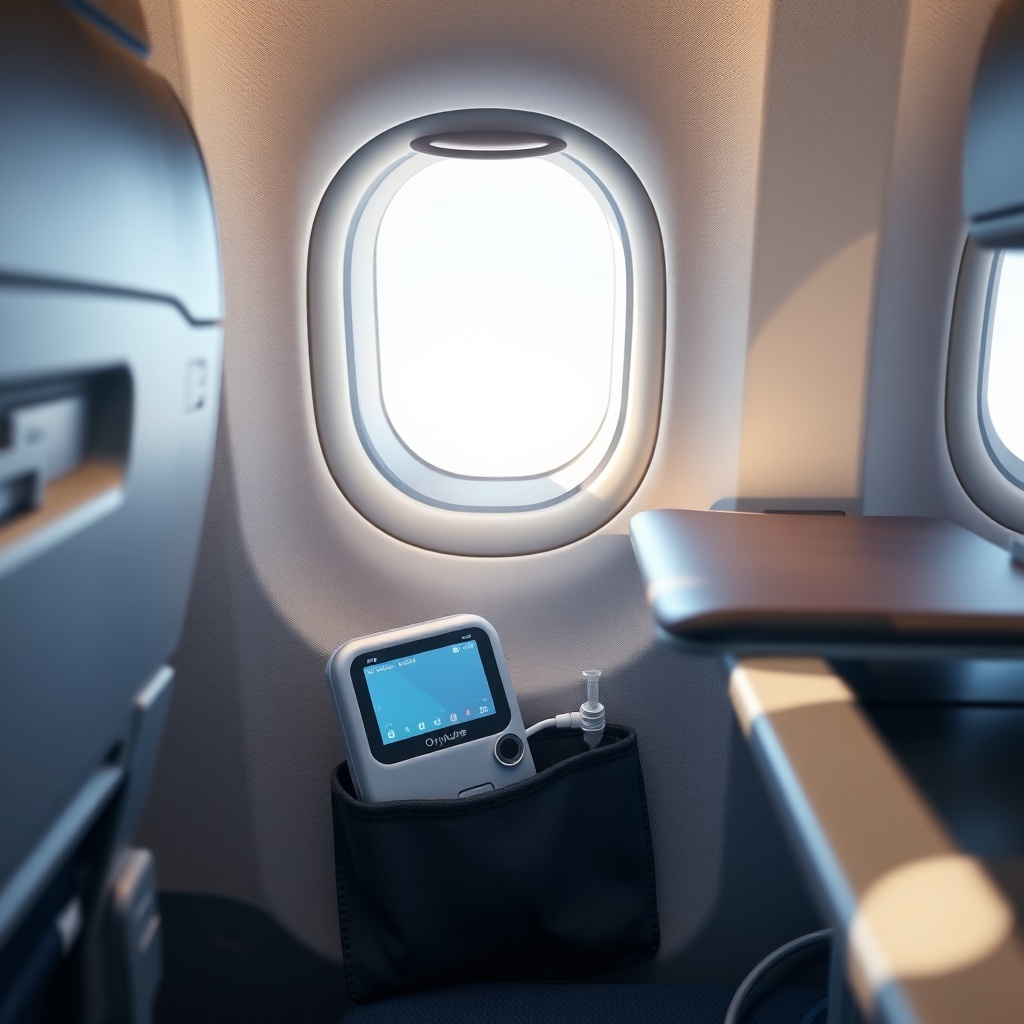
Yes, the OxyGuide Comfort is approved for use during all phases of flight, including taxi, takeoff, and landing. Unlike many other POCs that require stowage during critical phases, the OxyGuide Comfort’s rugged design and FAA testing allow it to remain operational. However, the airline crew may request that you stow the device if it does not fit securely under the seat in front of you or if it obstructs the aisle. For most passengers, the device fits comfortably in the overhead bin when not in use and can be kept at your seat during flight.
Important Operational Notes:
- Use the provided seat belt extension if the device is placed on the seat next to you.
- Ensure the concentrator is placed in seat pocket or under the seat with the power cord tucked away.
- Keep the device powered off during safety demonstrations if asked by crew.
Before your trip, review the OxyGuide Comfort Buying Guide: Key Features & What to Consider to understand the device’s dimensions and weight for easy carry-on compliance.
What Battery Life Should I Expect for a Transatlantic Flight?
Battery longevity is critical for long-haul travelers. The OxyGuide Comfort comes with a standard rechargeable lithium-ion battery pack rated for approximately 4.5 to 5 hours at a pulse dose setting of 2 (which corresponds to roughly 2 LPM continuous flow equivalent). At the maximum setting of 6 (approximately 6 LPM), battery life drops to about 1.8 hours. For transatlantic flights (e.g., New York to London, about 7 hours in the air), you will need at least two fully charged spare batteries, as most airlines require you to have enough battery power for 150% of the flight duration—meaning you need roughly 10.5 hours of total battery life. Always carry three batteries for a seven-hour flight to meet this margin comfortably.
Battery Life by Setting (Approximate):
| Setting (Pulse Dose) | LPM Equivalent | Standard Battery Life | Extended Battery Life (Optional) |
|---|---|---|---|
| 1 | ~1 LPM | 6.5 hours | 9.0 hours |
| 2 | ~2 LPM | 5.0 hours | 7.2 hours |
| 3 | ~3 LPM | 3.8 hours | 5.5 hours |
| 4 | ~4 LPM | 2.8 hours | 4.0 hours |
| 5 | ~5 LPM | 2.1 hours | 3.1 hours |
| 6 | ~6 LPM | 1.8 hours | 2.5 hours |
If you’ve encountered OxyGuide Comfort Battery Drain Issues: Common Causes and Fixes, we recommend reading that guide for troubleshooting tips before your flight.
How Do I Prepare the OxyGuide Comfort for Airline Check-In?
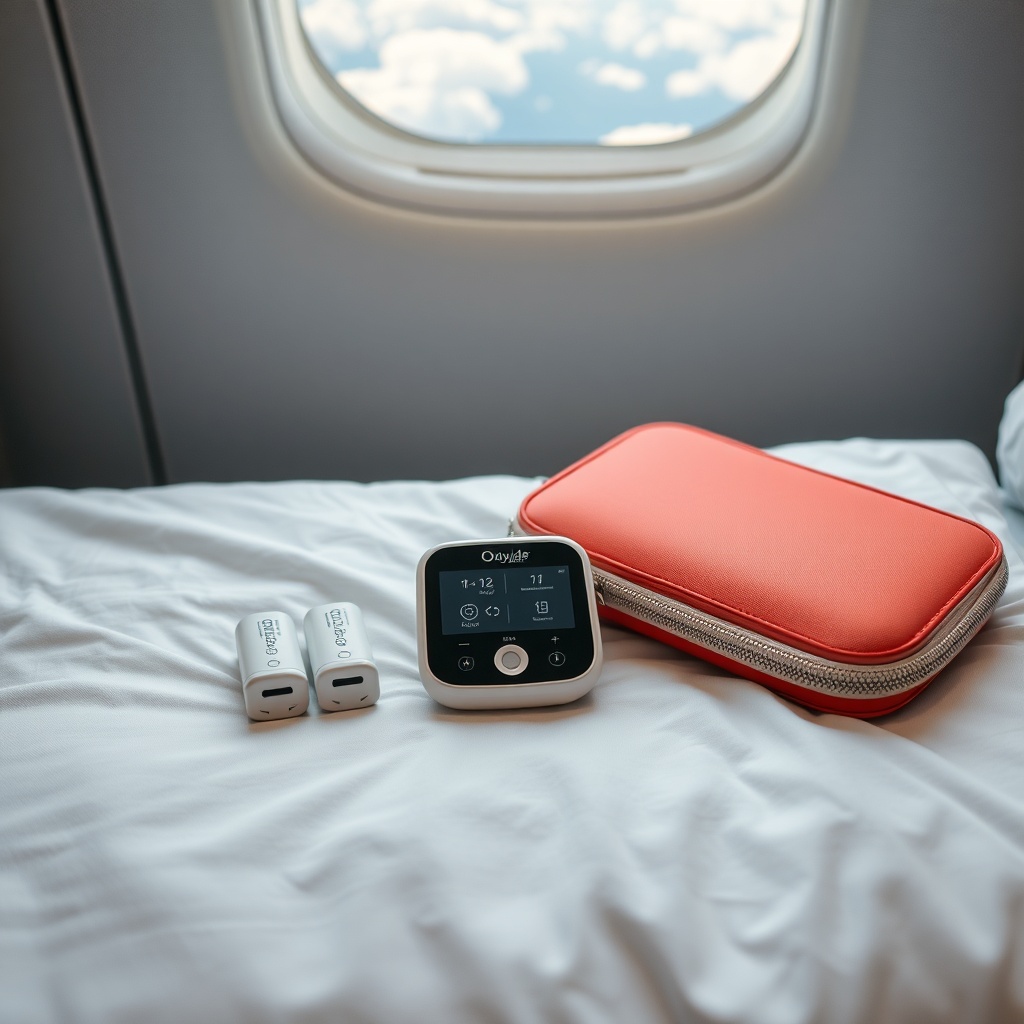
Preparation begins before you even leave home. First, download the airline’s medical equipment form (often called a “Medical Certificate for Portable Oxygen Concentrators”) from the airline’s website. Complete the form with your physician’s signature and fax or email it to the airline at least 48 hours in advance. Next, ensure your device is fully charged and that spare batteries are stored individually in protective cases to prevent short circuits. On travel day, arrive early—at least two hours before domestic flights and three for international—to allow for security screening and gate verification. Place the OxyGuide Comfort in its carry bag (usually included) and have the FAA approval sticker visible; TSA officers are trained to recognize approved POCs.
Checklist for Airline Travel:
- Obtain medical certificate and airline pre-approval (48 hours prior).
- Charge device to 100% and pack spare batteries (in protective sleeves).
- Pack the AC and DC power adapters (if the aircraft has a power port).
- Print copies of FAA approval letter and device user manual.
- Bring a copy of your oxygen prescription (though not always required).
For a thorough breakdown of what to consider before purchasing, the OxyGuide Comfort Buying Guide: Key Features & What to Consider offers in-depth advice on travel readiness and feature selection.
What Are the Noise Levels on the Plane?
One of the common concerns with POCs is noise disruption, especially on long flights where passengers try to sleep. The OxyGuide Comfort operates at a sound level of approximately 40-45 decibels (dB) during normal pulse dose delivery. For context, this is comparable to a quiet library or a soft whisper. At higher settings (5-6), the compressor cycles more frequently and may reach 48-50 dB, similar to a low conversation. Most users report that the white noise of the aircraft cabin easily masks the concentrator’s sound, making it nearly imperceptible. For a side-by-side noise comparison with a competitor, check out our OxyGuide Comfort vs Caire Freestyle Comfort: Noise Level Comparison.
Noise Level Data:
- At Setting 2 (ambient cabin noise level ~60-65 dB in flight): The OxyGuide Comfort is inaudible for most passengers.
- At Setting 6 during quiet periods (e.g., overnight): Some users report a faint humming, but it is rarely bothersome.
- Side benefit: The device features a “sleep mode” that reduces alarm sounds and display brightness for unobtrusive overnight use.
What Do Owners Say About Flying with OxyGuide Comfort?
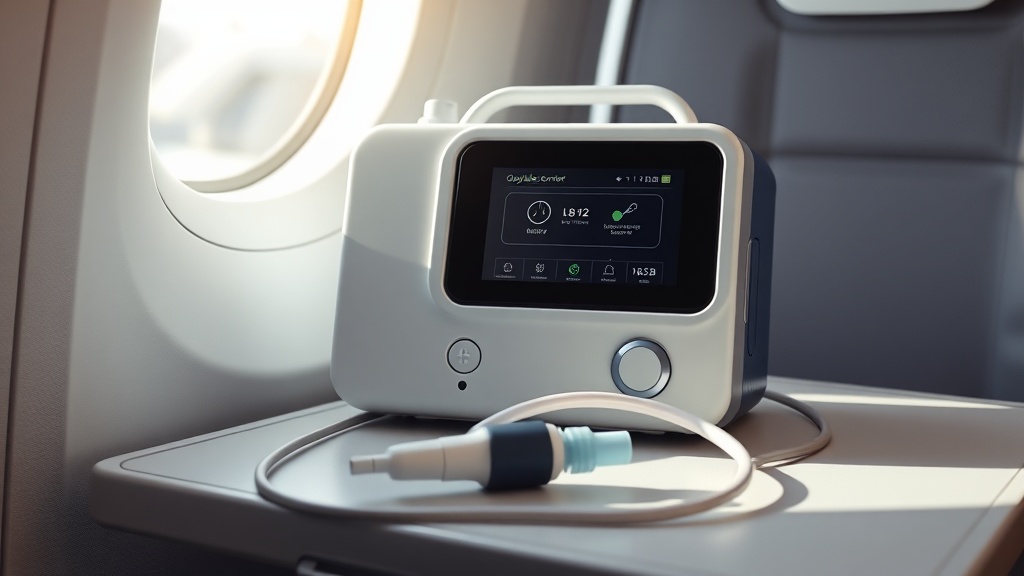
User feedback consistently highlights the device’s reliability and ease of use during air travel. Many owners appreciate the intuitive LCD screen that displays remaining battery time, pulse dose setting, and any error codes. One frequent flyer reported, “I’ve taken the OxyGuide Comfort on eight flights this year, including a 10-hour trip to Tokyo. The battery life is accurate as advertised, and the FAA approval sticker made check-in seamless. TSA didn’t even ask questions.” Another owner from the UK noted, “The device fits perfectly in the overhead bin and the carrying case is sturdy. I did need to buy an extra battery for long-haul, but it was worth the investment.”
Common Positive Themes:
- Simple FAA compliance process with major airlines.
- Reliable battery performance matching manufacturer claims.
- Compact form factor fits under standard economy seats.
- Customer support responsive to travel-related queries.
For a deeper look at how the OxyGuide Comfort compares to other brands, see the OxyGuide Comfort Buying Guide: How It Stacks Up Against Competitors.
Frequently Asked Questions
Q: Do I need a doctor’s note to fly with the OxyGuide Comfort?
A: Most airlines require a completed medical certificate, signed by your physician, verifying that you are fit to fly and that the device is necessary. Download the form from the airline’s website and submit it at least 48 hours before departure.
Q: Can I use the OxyGuide Comfort on all airlines?
A: Yes, because it is FAA-approved, it is accepted by all U.S. domestic airlines and most international carriers that follow FAA guidelines. However, some foreign airlines may have additional requirements; always check with the carrier.
Q: How many spare batteries can I carry on the plane?
A: The FAA allows lithium-ion batteries up to 100 watt-hours (Wh) each. The OxyGuide Comfort battery is rated at 98 Wh, so you can carry up to two spare batteries in your carry-on (not checked luggage). Check with your airline for specific limits.
Q: What if my device malfunctions during the flight?
A: Refer to the OxyGuide Comfort No Power: Troubleshooting Guide for immediate steps. Airlines are also required to provide backup oxygen in case of equipment failure; notify a flight attendant immediately if the device stops working.
Q: Does the OxyGuide Comfort work at high altitudes?
A: Yes. It is tested to operate at cabin pressures up to 10,000 feet. Since commercial aircraft typically maintain cabin pressure at 6,000 to 8,000 feet, the device functions normally. You may need to increase your setting slightly at altitude, as inspired oxygen pressure decreases.
Q: Can I charge the device during the flight?
A: Yes, the OxyGuide Comfort comes with a DC power adapter that plugs into the aircraft’s in-seat power port (if available). Many newer planes have standard AC outlets, but the DC adapter provides flexibility. Confirm with the airline if in-seat power is available on your flight.