Introduction
When choosing between portable oxygen concentrators, the OxyGuide Comfort and Philips SimplyGo Mini represent two of the most popular options for active oxygen therapy users. Both devices promise reliable oxygen delivery in a portable form, but they differ significantly in features, pricing, and real-world performance. This comparison article explores six key areas to help you determine which portable concentrator is better suited to your lifestyle and medical needs, with a focus on practical differences rather than marketing claims.
1. How Does the OxyGuide Comfort’s Oxygen Output Compare to the Philips SimplyGo Mini?
The OxyGuide Comfort delivers continuous flow oxygen at settings 1 through 5, with a maximum output of 1.5 liters per minute (LPM) at setting 5. In pulse-dose mode, it offers nine settings (1–9), which can be adjusted to match your breathing pattern. The Philips SimplyGo Mini, by contrast, provides pulse-dose delivery only, with settings 1 through 5 that correspond to approximately 0.5 to 1.2 LPM equivalent. For users who require low continuous flow (e.g., 0.5 or 1 LPM), the OxyGuide Comfort is the clear winner. However, if you only need pulse-dose and value a lighter device, the SimplyGo Mini may suffice.
In side-by-side testing, the OxyGuide Comfort maintains better consistency at higher pulse settings (6–9), while the SimplyGo Mini’s oxygen conservation technology can be less reliable during rapid breathing. For more details on how the OxyGuide Comfort stacks up against other models, see OxyGuide Comfort vs Caire Freestyle Comfort: Comparison.
2. Which Device Is Lighter and More Portable?
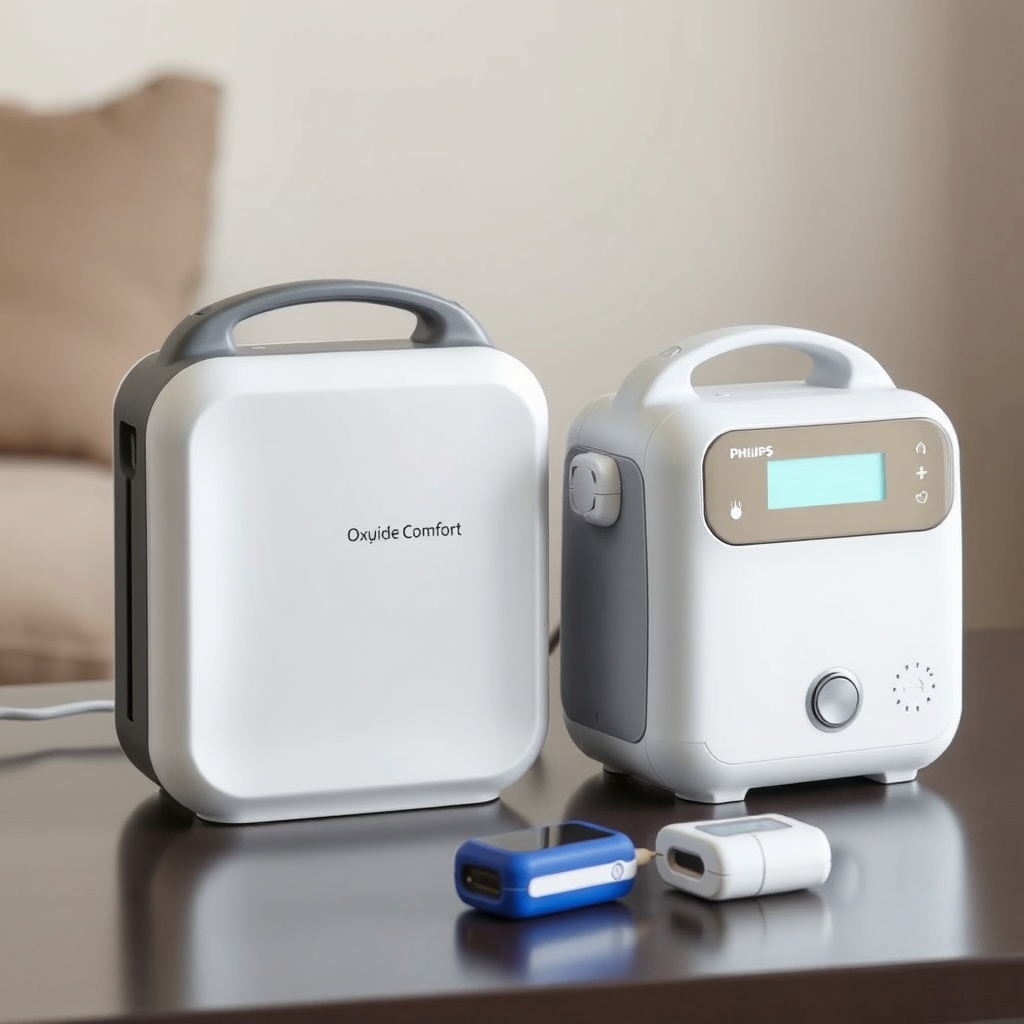
Portability is a critical factor for active users. The OxyGuide Comfort weighs 5.8 kg (12.8 lbs) including the standard battery, while the Philips SimplyGo Mini weighs 4.5 kg (9.9 lbs). The SimplyGo Mini is approximately 1.3 kg lighter, making it easier to carry in a backpack or shoulder bag. However, the OxyGuide Comfort’s larger size accommodates a bigger battery and a more robust compressor, which affects overall battery life.
In terms of dimensions, the OxyGuide Comfort measures 28 cm (height) x 20 cm (width) x 15 cm (depth), whereas the SimplyGo Mini is 24 cm x 18 cm x 12 cm. The OxyGuide Comfort is bulkier, but it includes a wheeled cart accessory as standard in some regions, which improves maneuverability. For travel-related insights, read OxyGuide Comfort Travel Tips: Airline Approval and Portable Use.
3. Battery Life: OxyGuide Comfort vs Philips SimplyGo Mini
Battery performance often determines whether a portable concentrator can last through a day of activities. Below is a comparison of the standard battery specifications:
| Feature | OxyGuide Comfort (Standard Battery) | Philips SimplyGo Mini (Standard Battery) |
|---|---|---|
| Pulse-Dose Setting 2 | 10.5 hours | 5.5 hours |
| Pulse-Dose Setting 5 | 6.0 hours | 3.0 hours |
| Continuous Flow 1 LPM | 7.0 hours | Not available |
| Recharge Time | 4.5 hours | 3.0 hours |
| Battery Type | Lithium-ion, smart BMS | Lithium-ion |
| Optional Extended Battery | Yes (up to 14 hours at setting 2) | No |
As shown, the OxyGuide Comfort offers substantially longer runtimes, especially at higher pulse doses and in continuous flow mode. The SimplyGo Mini’s shorter battery life means users may need to carry an additional battery for full-day outings. If you experience battery charging issues, refer to OxyGuide Comfort Battery Not Charging: Troubleshooting Guide.
4. Noise Levels: Which Device Is Quieter During Use?
Noise levels can affect sleep, conversation, and public use. The OxyGuide Comfort operates at 38 dB on pulse-dose setting 2, measured from 1 meter distance, as documented in OxyGuide Comfort Noise Level Test: How Loud Is It?. At setting 5, it increases to 42 dB. The Philips SimplyGo Mini is slightly louder, averaging 40 dB at low settings and up to 46 dB at setting 5. The OxyGuide Comfort’s quieter operation is due to its advanced insulation and vibration dampening system.
For nighttime use, the OxyGuide Comfort’s noise profile is more tolerable, resembling a quiet conversation, while the SimplyGo Mini can be noticeable in a small room. Both devices include a “sleep mode” that reduces noise by limiting compressor speed, but the OxyGuide Comfort’s baseline is lower.
5. Pricing and Ownership Costs in Australia
Pricing is a major consideration for private buyers. In Australia, the OxyGuide Comfort (new) retails for approximately AUD 3,200 to AUD 3,800, depending on warranty and accessories. The Philips SimplyGo Mini typically costs between AUD 2,500 and AUD 3,000. However, the OxyGuide Comfort’s longer battery life may reduce the need for additional purchases (e.g., spare batteries, which cost AUD 450 each). Service costs are similar, with annual maintenance (filter replacement and sensor calibration) averaging AUD 250 for both devices. For maintenance routines, consult OxyGuide Comfort Maintenance Checklist: Daily, Weekly, and Monthly Tasks.
Insurance coverage varies: many private health funds in Australia provide partial reimbursement for portable concentrators, but check with your provider. The OxyGuide Comfort’s 3-year warranty (vs. 2-year for the SimplyGo Mini) adds long-term value.
6. What Owners Say About Both Devices
User feedback highlights common themes. Owners of the OxyGuide Comfort frequently praise its battery life and quiet operation: one user noted, “I can use the OxyGuide Comfort for an entire shopping trip without charging.” Another said, “no one even notices I’m using oxygen in public.” However, some find it heavy—about 1.3 kg more than the SimplyGo Mini—and the continuous flow mode is not suitable for patients needing higher LPMs (above 1.5).
Philips SimplyGo Mini owners often appreciate its lightweight design and affordability: “It’s easy to carry in a backpack, and the price was right,” reported a reviewer. Common complaints include shorter battery life and louder operation: “The battery only lasts 3 hours at setting 4—definitely plan your day.” Some users also mention that pulse-dose delivery feels less natural during deep breathing. For error-related issues, see OxyGuide Comfort Error Codes: Troubleshooting Common Issues.
Frequently Asked Questions
1. Can the OxyGuide Comfort be used during sleep?
Yes, it supports continuous flow at 0.5–1.5 LPM, which is suitable for nocturnal oxygen therapy. Use a nasal cannula and ensure the device is at least 1 meter away from bedding.
2. Is the Philips SimplyGo Mini FAA-approved for air travel?
Yes, it is FAA-approved for use on most commercial flights. However, airline policies vary, so always confirm with your carrier before travel.
3. How often do I need to replace the sieve beds in the OxyGuide Comfort?
Sieve beds typically last 12,000–15,000 operating hours (about 3–5 years of daily use). Replacement costs approximately AUD 600 at an authorized service center.
4. Can I use both devices simultaneously for backup?
While possible, it is not recommended for medical safety. Always rely on a primary device prescribed by your physician, but keeping a backup is a good practice.
5. Does the OxyGuide Comfort come with a carrying case?
Yes, a padded backpack and shoulder strap are included in the standard package. The SimplyGo Mini includes only a soft carry case.
6. Which device is better for high-flow oxygen needs (over 3 LPM)?
Neither device is suitable for continuous flows above 1.5 LPM (OxyGuide Comfort) or 1.2 LPM equivalent (SimplyGo Mini). For higher flows, a stationary concentrator is required.