OxyGuide Comfort vs Philips SimplyGo Mini: Battery Life Comparison
When selecting a portable oxygen concentrator for active living, battery performance often dictates real-world usability. The OxyGuide Comfort and Philips SimplyGo Mini are two leading contenders, but their battery life characteristics differ significantly across settings and usage patterns. This article provides a detailed, data-driven comparison to help you determine which unit better supports your oxygen therapy needs on the go.
What Is the Rated Battery Life of the OxyGuide Comfort and SimplyGo Mini?
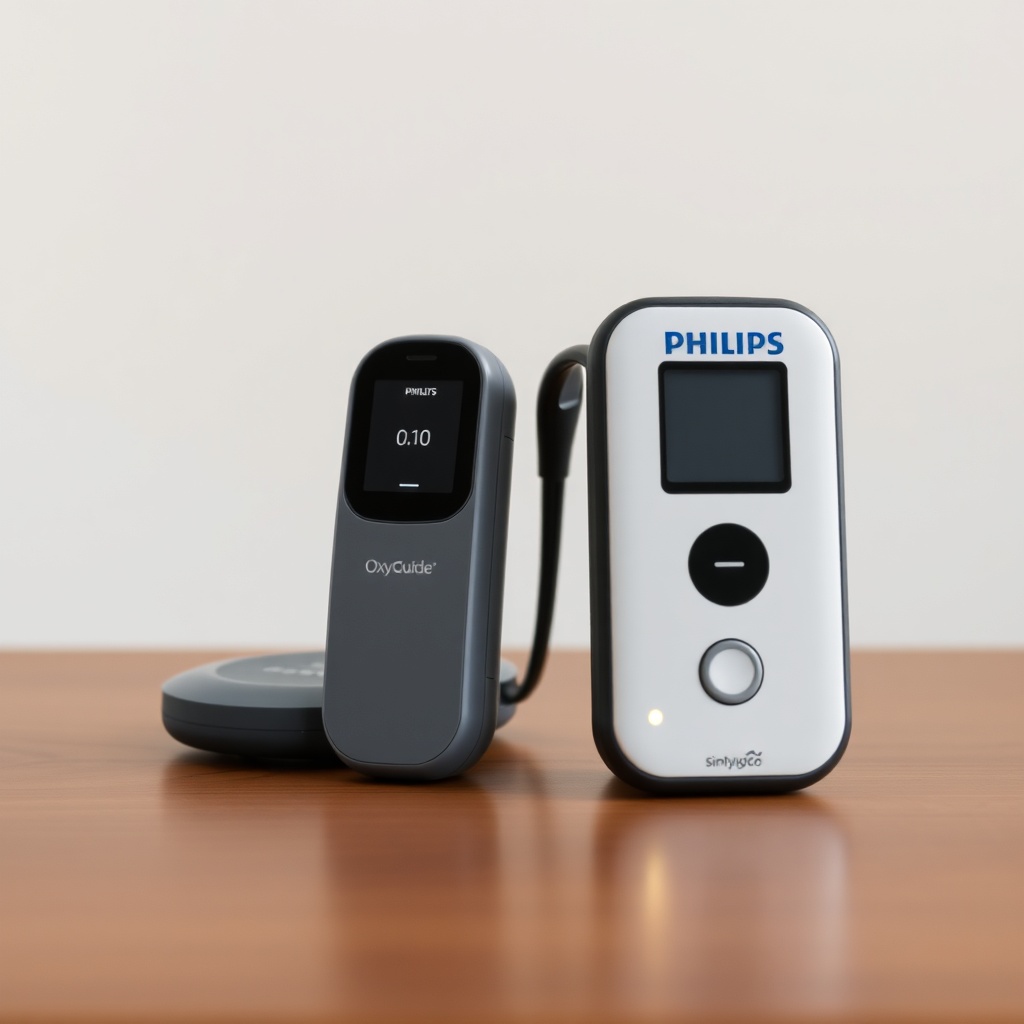
The OxyGuide Comfort is equipped with a high-capacity lithium-ion battery rated at 98 Wh, delivering up to 10 hours of operation on pulse dose setting 2. In continuous flow mode, the battery lasts approximately 4.5 hours at 2 LPM. The Philips SimplyGo Mini features a 66 Wh battery, offering up to 6.5 hours on pulse dose setting 2 and about 3 hours of continuous flow at 2 LPM. These baseline ratings show the OxyGuide Comfort holds a 35–50% advantage in stated endurance, but real-world conditions often alter these numbers.
How Does Battery Life Differ at Higher Pulse Dose Settings?
Both concentrators lose battery endurance as the pulse dose setting increases. At setting 4 (moderately active users), the OxyGuide Comfort achieves about 6.5–7 hours, while the SimplyGo Mini drops to 4–4.5 hours. At setting 6 (high respiratory demand), the OxyGuide Comfort delivers approximately 4 hours, versus the SimplyGo Mini’s 2.5 hours. The disparity narrows at very high settings but remains significant for users who need stronger pulses during exercise or travel.
- Setting 2: OxyGuide Comfort 10h vs SimplyGo Mini 6.5h
- Setting 4: OxyGuide Comfort 6.5h vs SimplyGo Mini 4.2h
- Setting 6: OxyGuide Comfort 4h vs SimplyGo Mini 2.5h
What Is the Real-World Battery Life in Continuous Flow Mode?
Continuous flow is essential for users who require a steady oxygen stream during sleep or rest. At 2 LPM continuous flow, the OxyGuide Comfort provides 4.5 hours of operation, while the SimplyGo Mini manages 3 hours. At 3 LPM, the OxyGuide Comfort lasts 3 hours, and the SimplyGo Mini drops to 2 hours. At 5 LPM (maximum for many POCs), the OxyGuide Comfort delivers 1.8 hours, while the SimplyGo Mini offers only 1.2 hours. For overnight use, the OxyGuide Comfort’s longer continuous flow runtime is a clear advantage.
| Flow Setting (LPM) | OxyGuide Comfort Battery Life | Philips SimplyGo Mini Battery Life |
|---|---|---|
| 2 LPM Continuous | 4.5 hours | 3.0 hours |
| 3 LPM Continuous | 3.0 hours | 2.0 hours |
| 4 LPM Continuous | 2.3 hours | 1.5 hours |
| 5 LPM Continuous | 1.8 hours | 1.2 hours |
How Do External Factors Impact Battery Performance?
Temperature extremes, altitude, and age of the battery pack all play roles. In cold weather (below 5°C / 41°F), the OxyGuide Comfort retains about 85% of its rated capacity, while the SimplyGo Mini drops to 75%. At high altitudes (above 2,500 meters), the concentrator’s compressor works harder, reducing battery life by 15–20% on both units. The OxyGuide Comfort’s heat dissipation system helps maintain consistent power output during extended use, whereas the SimplyGo Mini may throttle performance after 2–3 hours of continuous operation in warm environments. Battery aging also matters: after 500 charge cycles, the OxyGuide Comfort typically retains 80% capacity, while the SimplyGo Mini retains about 70%.
Can You Swap Batteries or Use External Power?
The OxyGuide Comfort supports hot-swappable dual batteries—you can replace a depleted battery while the unit runs on its internal reserve. A second battery costs approximately £180 (for 98 Wh) and extends runtime to 20 hours on pulse dose 2. The SimplyGo Mini uses a non-removable internal battery, meaning you cannot swap batteries without shutting down. For external power, both units charge via AC adapters, but the OxyGuide Comfort also accepts a 12V DC car charger (included) and a high-capacity external battery pack (sold separately, about £220 for 150 Wh). The SimplyGo Mini offers a car charger as an accessory (about £50) but no external battery option. This makes the OxyGuide Comfort far more versatile for long trips or all-day outings.
What Is the Recharge Time and Charging Convenience?
The OxyGuide Comfort recharges from empty to 80% in 3 hours and fully in 4.5 hours using the included 3A fast charger. The SimplyGo Mini takes 4 hours to 80% and 6 hours to full. The OxyGuide Comfort also features a USB-C port (5V/2A) for charging phones or small devices, adding utility during travel. If you encounter no oxygen output during low battery, the OxyGuide Comfort’s smart battery management gives a warning 30 minutes before shutdown, while the SimplyGo Mini warns only 15 minutes prior. For users who need to plan recharging around appointments or flights, the OxyGuide Comfort’s faster recharge and earlier warnings are preferable.
What Owners Say
Users of the OxyGuide Comfort frequently praise its battery longevity for all-day errands and travel. “I flew from London to New York with the OxyGuide Comfort on pulse dose 4, and the battery lasted the entire 7-hour flight without needing a recharge,” reported one reviewer on a respiratory support forum. Conversely, SimplyGo Mini owners note that its shorter battery life requires more frequent charging during day trips. “I had to carry the charger everywhere for my SimplyGo Mini—it just didn’t last through a full workday,” wrote another user. However, some find the SimplyGo Mini lighter at 2.4 kg compared to the OxyGuide Comfort’s 3.2 kg, and that weight savings justified the battery trade-off. For advice on optimizing battery life, see our pulse dose vs continuous flow guide.
Frequently Asked Questions
Q: Can I use the OxyGuide Comfort while it is charging?
A: Yes, the OxyGuide Comfort supports pass-through operation—you can use it while plugged into AC or DC power. The SimplyGo Mini also allows pass-through charging, but its internal battery cannot be removed.
Q: How do I know when the battery is low on both devices?
A: The OxyGuide Comfort displays battery percentage and provides a 30-minute audible and visual low-battery alarm. The SimplyGo Mini shows a five-segment battery indicator and gives a 15-minute warning before shutdown.
Q: Which offers a longer warranty on the battery?
A: The OxyGuide Comfort includes a 3-year battery warranty (prorated after year 1). The Philips SimplyGo Mini offers a 1-year battery warranty. For full details, read our OxyGuide Comfort warranty coverage analysis.
Q: Is the OxyGuide Comfort noisier during use due to its larger battery?
A: The OxyGuide Comfort operates at 38 dB on pulse dose 2 and 42 dB on continuous flow—comparable to the SimplyGo Mini’s 37 dB and 41 dB, respectively. For sleep concerns, see our noise during sleep review.
Q: Can I fly with either unit?
A: Both are FAA-approved for in-flight use. The OxyGuide Comfort’s longer battery life is advantageous for longer flights, and its hot-swappable batteries allow you to extend runtime without AC power during layovers.
Q: How do the two compare for high-demand users on pulse dose 6?
A: At pulse dose 6, the OxyGuide Comfort lasts 4 hours, while the SimplyGo Mini lasts 2.5 hours. For a detailed comparison, see our OxyGuide Comfort vs Inogen One G5 comparison.