Is the Inogen One G5 Right for Your Oxygen Therapy?
When you’re considering a portable oxygen concentrator, the Inogen One G5 often tops the list for its compact size and high pulse dose delivery. But before you commit to what is a significant investment for your respiratory health, you need to understand the key buying factors. This guide will walk you through the most important questions to ask yourself before purchasing an Inogen One G5.
1. What Pulse Dose Settings Do You Actually Need?
The Inogen One G5 delivers oxygen in pulse doses, not a continuous flow. This means it releases a burst of oxygen only when you inhale. Understanding your prescribed Inogen One G5 pulse dose settings is critical. The G5 offers settings from 1 to 6, where setting 1 is the lowest and setting 6 delivers the highest oxygen volume per breath.
Most users with moderate activity levels find settings 2 to 4 sufficient for daytime use. However, if your doctor prescribes a setting above 5 for most of your waking hours, the G5’s battery life will drain much faster, and you may need to carry extra batteries. At setting 6, a standard battery lasts roughly 1.5 to 2 hours under active use, which is significantly less than the advertised 4.5 hours at setting 2. Always check your prescription and simulate your typical day’s use to see if the battery range works for you.
A common mistake is buying a unit with an insufficient battery plan. For heavy users, consider purchasing a second extended-life battery (the G5 uses a 4-cell or 8-cell battery). The 8-cell battery adds weight but nearly doubles your runtime.
2. How Will You Travel with the G5?
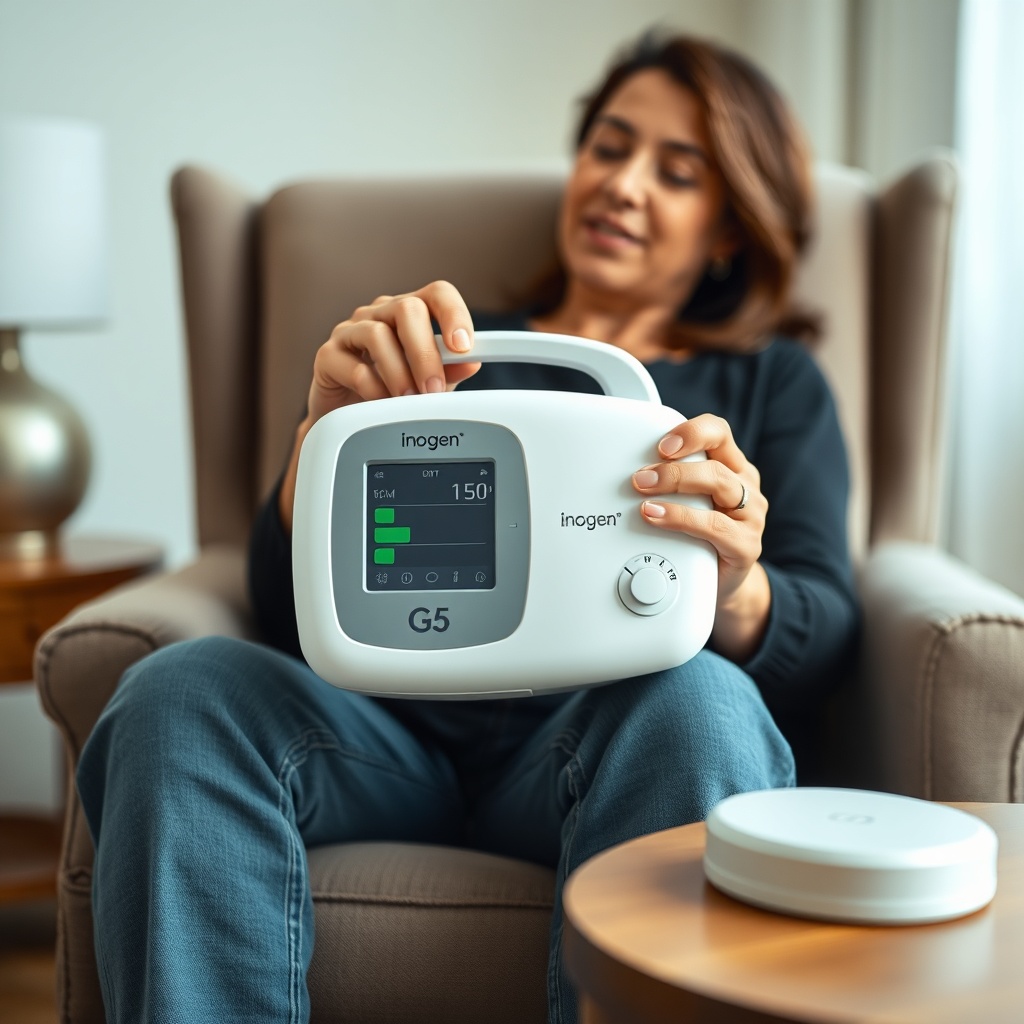
The G5 is FAA-approved for air travel, which is a major selling point. However, “approved” does not mean hassle-free. The device itself weighs about 4.7 pounds with a 4-cell battery, making it one of the lighter high-output concentrators. But the battery restrictions for air travel still apply.
You can take multiple batteries, but each must be individually protected from short circuits (keep them in their plastic cases). Most airlines allow up to two spare batteries in your carry-on bag. The G5 itself must be your carry-on item—you cannot store it in checked luggage. The key question is: how long is your flight plus your ground time? If you have a 6-hour flight and a 2-hour layover, you’ll need enough batteries to cover about 8 hours of use.
Also, consider the best travel cases for Inogen One G5. A padded shoulder case is essential for moving through an airport, but you also need a case that fits under the airplane seat. The official Inogen case is well-padded but doesn’t have side pockets for extra batteries—many users prefer third-party cases with battery storage.
| Accessory | Recommended for |
|---|---|
| Standard 4-cell battery (single unit) | Usually not urgent – fine for short trips under 2 hours |
| Extended 8-cell battery | Needs attention soon – required for day trips or flights over 3 hours without charging |
| External battery charger | Usually not urgent – but very helpful for charging batteries separately outside the concentrator |
| Travel case with battery compartment | Needs attention soon – essential for air travel to keep spare batteries organized and protected |
3. How Loud Is It Really?
The Inogen One G5 has a stated noise output of 38 dBA at setting 2. That’s quieter than a typical conversation but louder than a library. However, at higher settings (5 and 6), the compressor runs faster and the sound level rises noticeably to around 45 dBA. In a quiet room, you will hear the “hissing” pulse of oxygen delivery and the compressor cycling.
For sleeping, many users report needing the unit at least six feet away from their head, or using a longer cannula to run the machine into a closet or hallway. The G5 is not a silent device. If you are very sensitive to background noise, test the unit at your prescribed setting in a quiet room before buying. Some find the sound soothing and rhythmic; others find it disruptive. This is a highly personal factor.
4. What Error Codes Should You Expect?
No concentrator is error-proof, and the G5 can display several Inogen One G5 error codes. The most common ones are “Check Cannula” (usually a kinked tube), “Low Battery,” and “System Error” (which may require a restart). More serious errors like “Service Required” indicate an internal fault.
Before buying, understand that the G5 has a self-diagnostic mode that runs each time you power it on. If it fails, it will beep and show a code. If you buy a used or refurbished unit, ask the seller for the service history—machines that have been serviced for “oxygen sensor out of range” or “compressor failure” are higher risk. Always buy from a reputable dealer that offers at least a 30-day return window and a warranty. A new G5 typically comes with a 3-year warranty on the device and 1 year on the battery.
5. What Does It Cost, and Is It Worth It?
As of early 2025, a new Inogen One G5 typically retails for around $3,500 to $4,200 USD for the base system (concentrator, 4-cell battery, charger, carrying case). Adding an 8-cell battery and external charger pushes the total to roughly $4,500 USD. This is a premium price, but you are paying for a device that is significantly smaller and lighter than many competing models with similar output.
If the price is too high, consider renting for a month (typically $200–$300 USD) to test it in your daily life. Many oxygen supply companies offer lease-to-own programs. Also check if your insurance covers portable concentrators—Medicare Part B may cover a portion if you meet the criteria for home oxygen therapy. The investment is justifiable if you value portability and need high doses while remaining active. However, for very sedentary users, a less expensive continuous flow unit might be a better value.
What Owners Say
Real-world feedback from G5 owners on forums and support groups reveals two consistent themes.
Positive: “I can finally walk to the mailbox and back without feeling winded. The G5 is light enough to carry on a shoulder strap, and the pulse dose keeps my O2 saturation above 90% at setting 4 during light activity.”
Negative: “The battery life at setting 6 is disappointing. I need two 8-cell batteries just to get through a 5-hour outing. Also, the unit beeps if you set it down unevenly—it needs to be level to work properly.”
Frequently Asked Questions
Can I use the Inogen One G5 while charging?
Yes. The G5 can operate while plugged into AC power or a car charger. The battery will charge simultaneously. This is useful for long car trips or when you are at home near an outlet.
How often do I need to replace the filters?
The external foam filter should be washed every two weeks and replaced every three months. The internal particle filter needs replacement every six months. Using dirty filters reduces oxygen output and can trigger error codes.
Is the Inogen One G5 compatible with a CPAP machine?
No. The G5 is a pulse-dose device meant for breathing through a nasal cannula. It is not designed for use with a CPAP mask. You would need a continuous flow concentrator for that application.
How do I clean the Inogen One G5?
Wipe the exterior with a soft, damp cloth. Do not use alcohol or abrasive cleaners. Clean the cannula weekly with mild soap and water. Do not submerge the device in water.
What is the warranty on the Inogen One G5?
New units have a 3-year limited warranty on the device, 1 year on the battery, and 1 year on the power supply. Extended warranties can be purchased from some dealers.
Can I use the Inogen One G5 while sleeping?
Yes, but only if your doctor approves it. The G5 has a sleep mode that adjusts the pulse timing to work with slower breathing rates. However, the noise level may be disruptive to some people.