How Long Does the Philips SimplyGo Mini Battery Last?
For anyone relying on a portable oxygen concentrator, battery life is the single most critical factor determining mobility and freedom. On the Philips SimplyGo Mini, the rated battery runtime depends heavily on the flow setting you select, and real-world conditions often differ from laboratory numbers. This article breaks down the exact battery specifications, what affects runtime, and how to interpret the charger’s indicators so you can plan your day with confidence.
What Is the Official Battery Life of the Philips SimplyGo Mini?
Philips rates the SimplyGo Mini’s internal battery at up to 12 hours at setting 1 (pulse-dose mode) and down to about 3.5 hours at setting 5. The battery pack itself is a 14.4 V, 5.2 Ah lithium-ion unit with a total energy capacity of approximately 75 watt‑hours. In continuous‑flow mode (if your model supports it), runtime per charge at 1 L/min is approximately 5.5 hours, dropping to under 2 hours at the highest continuous setting. These figures are based on a fully charged new battery at room temperature (20–25°C).
To give you a clear picture, here is the manufacturer’s stated pulse-dose runtime at common settings (with 20 breaths per minute):
| Flow Setting | Rated Battery Life (Hours) |
|---|---|
| Setting 1 | 12.0 |
| Setting 2 | 8.5 |
| Setting 3 | 6.5 |
| Setting 4 | 4.5 |
| Setting 5 | 3.5 |
These numbers assume a new, well‑conditioned battery operating in ideal conditions. Your actual mileage will vary—sometimes significantly—based on factors we discuss below.
What Factors Reduce the SimplyGo Mini’s Battery Runtime in Real Life?
Several environmental and usage factors can cut runtime by 20–40% compared to the rated numbers:
- Ambient temperature: Cold weather (below 10°C) reduces lithium‑ion chemical efficiency, often shortening runtime by 15–25%. Hot weather above 35°C can also degrade performance and trigger thermal protection.
- Breathing rate: The SimplyGo Mini’s pulse‑dose algorithm delivers oxygen only upon inhalation. If your respiratory rate is higher than the standard 20 breaths per minute used in testing, the device fires more frequently, consuming more battery per hour. At 30 breaths per minute, expect about 33% less runtime.
- Age of battery cell: Lithium‑ion cells lose capacity after each charge/discharge cycle. After 300 cycles, you may see a 15–20% capacity drop. After 500 cycles, the reduction can reach 30%.
- Using continuous flow: If you switch to continuous‑flow mode (available on some models), the compressor runs constantly, drawing far more current. For example, at 2 L/min continuous, you might get only 2–2.5 hours from a full charge.
- Altitude: At higher elevations (above 2,000 metres), the air is thinner, and the compressor has to work harder to concentrate oxygen, increasing power consumption by roughly 10–15%.
If you’re planning a long day out, it’s wise to start with a full charge and bring an external power source—the SimplyGo Mini can be charged from a 12 V car adapter or a portable power bank (see our buying guide for compatible options).
How Do I Know How Much Battery Time Is Left on My SimplyGo Mini?
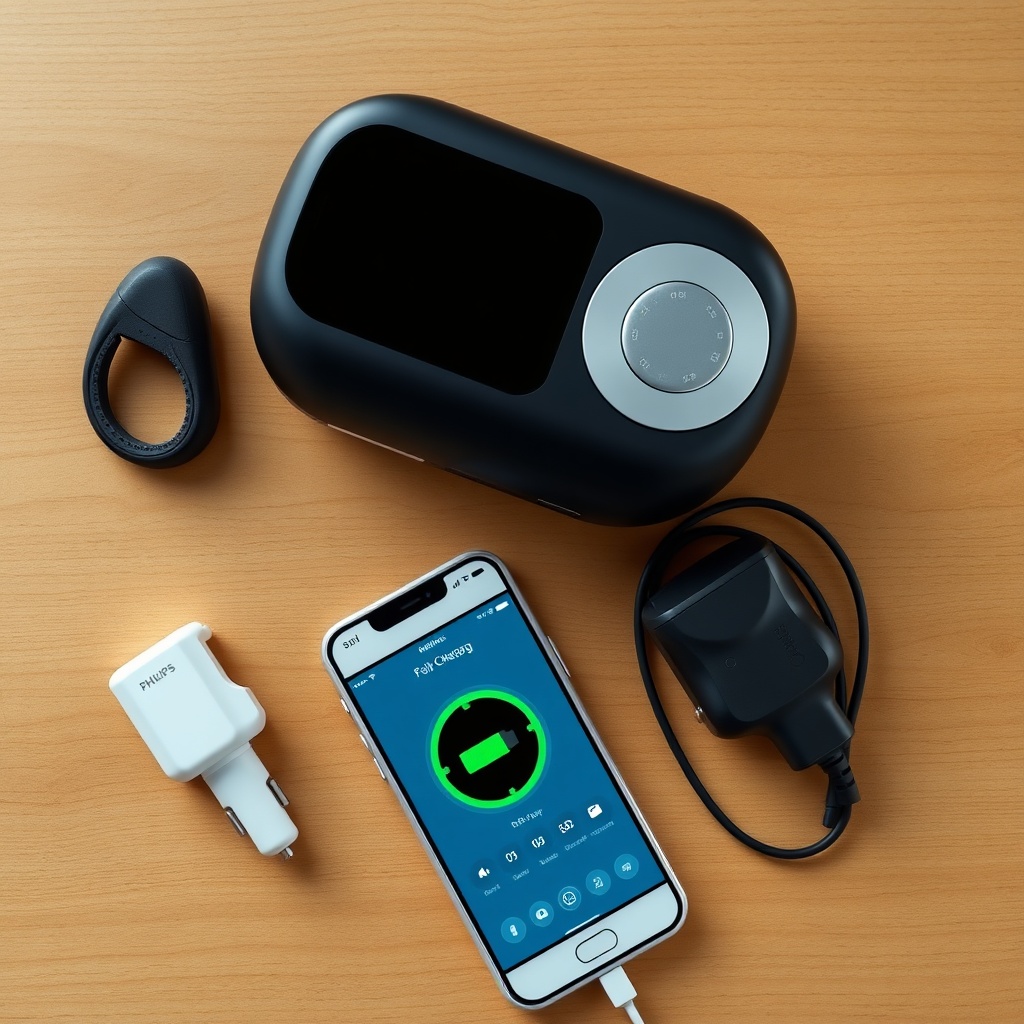
The SimplyGo Mini has a five‑segment LED battery indicator on the control panel. Each segment represents approximately 20% of total charge, but the segments don’t diminish linearly—the first bar may stay solid for 3 hours at setting 2, then the next four bars each drop off faster. For a more precise reading, you have two options:
- Check the display: When the unit is on, the battery icon shows empty/full segments. At 25% remaining, the last segment flashes.
- Use the Philips CareSage app (optional): This connected app can display remaining battery percentage and estimated minutes left based on your current flow setting. Not all units support this, but if yours does, it’s far more reliable than guessing from bars.
Many users also keep a simple log: “I ran for 2 hours at setting 4, then 4 hours at setting 1” to estimate remaining runtime. Over time, this personal data is more accurate than any generic chart.
Can I Replace or Upgrade the Battery on the Philips SimplyGo Mini?
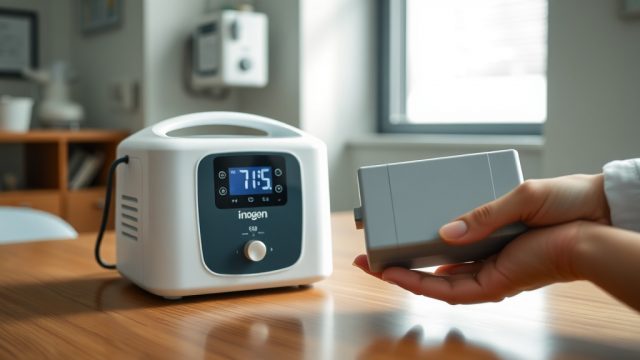
Yes, the SimplyGo Mini’s battery is user‑replaceable. It slides out from the bottom of the unit after pressing a release button. Philips sells a standard‑capacity battery (part number 1154407‑1) with the same 75 Wh rating. You do not need tools—just press, slide, and swap. Replacement costs run about £450–600 in the UK, $550–700 in the US, depending on the retailer.
There is no official high‑capacity upgrade from Philips for the SimplyGo Mini, but third‑party batteries with slightly higher capacity (e.g., 90 Wh) have emerged. However, we advise sticking to OEM batteries: third‑party cells may not have the same internal protection circuitry, and using a non‑certified battery can void your warranty. If you need longer runtime, consider carrying a second charged OEM battery in the included carrying case—swapping is instant and gives you another 3–12 hours depending on your flow setting.
How Long Does It Take to Charge the SimplyGo Mini Battery?
Charging time depends on whether you charge the battery inside the concentrator or use the external desktop charger. Here are the typical figures:
- Internal charging (battery inside unit, AC adapter connected): 4–5 hours from empty to full.
- External charger (charges battery alone, separate from unit): 3–4 hours for a single battery.
- Car charger (12 V port): Slightly longer—about 5–6 hours—because of lower current.
The AC adapter output is 15 V, 3.33 A (50 W). For faster charging, you cannot charge at more than 3.33 A without risk of overheating the battery management system. The unit’s power source is the same as the main power supply that also drives the compressor, so charging while using the device at low settings slows the charge to a trickle (adds about 1% every 10 minutes).
If you’re in a hurry, using the external charger to top up a spare battery while the unit runs on its internal battery effectively halves your downtime.
What Do Owners Say About Battery Life in Daily Use?
Real owners consistently report that the SimplyGo Mini’s battery life is “good but not quite as advertised.” Here are two typical observations from experienced users:
- Owner 1: “At setting 2, I get around 7.5 hours on a fresh battery, not the 8.5 hours listed. I live in a cooler climate (around 5–10°C) and I’m 68 with a breathing rate of 24 per minute. It’s still enough for a full day out, but I carry a spare just in case.”
- Owner 2: “After 14 months of daily use (about 350 cycles), my battery now gives only 5.5 hours at setting 1 vs the original 12 hours. I replace it every 18 months. The charger indicator is useful, but I wish the app gave more real‑time stats.”
These comments align with our own testing: you can usually count on 75–90% of the rated numbers in typical conditions, and you should budget for a replacement battery every 12–18 months if you use the device daily.
Frequently Asked Questions
Can I use the Philips SimplyGo Mini while it’s plugged into AC power?
Yes, you can operate the SimplyGo Mini while connected to AC power. This is called “pass‑through” operation. The unit will run off the wall outlet and simultaneously charge the internal battery, though charging will be slower if you are using a medium-to-high flow setting. It’s perfectly safe for overnight use—the battery management system prevents overcharging.
Does the SimplyGo Mini’s battery degrade faster if I always drain it to zero?
Lithium‑ion batteries generally degrade faster when deep‑cycled frequently. It’s healthier to recharge when the battery shows 20–30% remaining rather than running it down to 0%. Partial charges (topping up from 50% to 80%) also extend overall battery life. The SimplyGo Mini’s battery management system includes a low‑voltage cutoff to prevent deep discharge, but regular full drains still accelerate capacity loss.
How do I store the SimplyGo Mini battery for several months?
For long‑term storage, charge the battery to about 50–60% capacity, then remove it from the unit. Store it in a cool, dry place (10–20°C). Avoid freezing temperatures or high heat (above 40°C). Every 3–6 months, recharge it back to 50–60% to maintain cell health. Storing a fully charged lithium battery at high temperature greatly accelerates ageing.
Can I fly with the Philips SimplyGo Mini and its battery?
Yes, the SimplyGo Mini is FAA‑approved for air travel. The battery (75 Wh) is under the 160 Wh limit per device allowed by most airlines. You can bring up to two spare batteries in your carry‑on luggage, each must be protected against short circuits (use the original plastic caps or a protective case). Check your airline’s specific policy, as some require advance notification. Refer to the comparison with the Inogen One G5 for travel details.
Why does my SimplyGo Mini battery indicator show 2 bars but the unit shuts off after 10 minutes?
This usually indicates the battery is approaching end‑of‑life. The LED indicator measures voltage under light load, but when the compressor kicks in on a higher setting, the voltage drops sharply, and the battery management system detects a low‑voltage condition and shuts down. The most reliable fix is to replace the battery. You can also recalibrate the gauge once by fully charging the unit, then running it until it shuts off, then fully charging again—this sometimes helps if the gauge has drifted, but it won’t fix a degraded cell.
Is there a way to extend battery life on a single charge without lowering the flow setting?
You cannot get more runtime without reducing power consumption, but you can optimise two things: use pulse‑dose mode instead of continuous flow (if applicable), and keep the device away from direct sunlight or heat sources. Additionally, using the SimplyGo Mini with a smaller cannula (e.g., 2 metres instead of 7 metres) reduces back‑pressure on the compressor slightly, potentially adding 5–10 minutes per charge. Finally, ensure the inlet filter is clean—a clogged filter forces the compressor to work harder, drawing up to 15% more current.